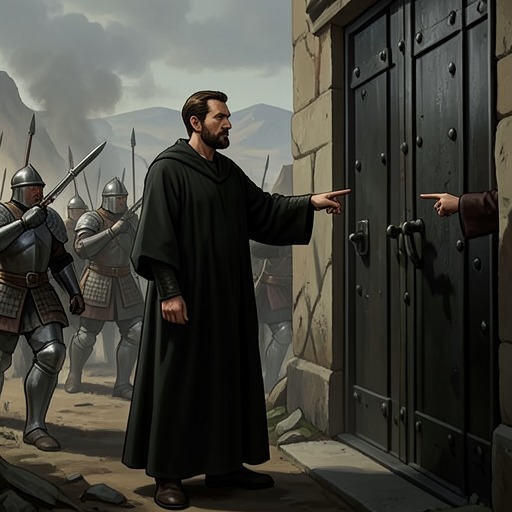
Yiling
The Romance of the Three KingdomsYiling is a strategically important town in the struggle for Nanjun and a turning point in the larger conflict between Sun Quan and Xuande. Its shifting fortunes show how control of a fortified place depends not just on winning an engagement, but on relief routes, deception, and the ability to act on the enemy’s movements; later, the wider region is linked to the destruction of Xuande’s army and the retreat of Lu Xun’s forces.
Setting and Strategic Role
Yiling matters because it helps defend Nanjun. When Cao Ren sends troops to secure the town, its position shapes the movements of both armies: Gan Ning’s advance threatens the northern defenders, while the siege of Gan Ning draws Zhou Yu away from his wider objective. The town thus becomes a point where the struggle for Nanjun expands into a contest over the approaches and the ability to relieve forces in danger.
The story presents Yiling’s importance through successive changes in the balance of forces rather than through a separate description of its architecture or population. An attack on the town, its capture, and an attempted relief each alter what the commanders can risk elsewhere. The town’s value lies in that operational position: possession can expose an army to encirclement, while a successful relief can restore the initiative.
The Struggle for Yiling and Nanjun
Zhou Yu first sends an advance force toward Nanjun, but Cao Ren’s troops defeat it. The fighting then reveals the importance of Yiling to Nanjun’s defence, and Cao Ren dispatches men to hold it. When Gan Ning advances on Yiling, Cao Ren’s men come out to attack and are driven back. Gan Ning enters the town, only to find himself almost immediately besieged by northern forces.
News of the siege brings Zhou Yu to Gan Ning’s aid. Zhou Yu’s main army joins Gan Ning’s troops and inflicts a major defeat on the besiegers. But the result does not settle the campaign. Zhou Yu turns back toward Nanjun and encounters a force Cao Ren has sent to assist the northern army at Yiling. That engagement ends without a clear decision; worn down and unable to continue, Cao Ren returns to Nanjun, while Zhou Yu withdraws to his camp.
The loss of Yiling leaves Cao Ren in an increasingly difficult position. He opens Cao Cao’s secret letter and orders his men to prepare to abandon Nanjun at dawn, while keeping banners displayed on the walls to make the city appear fully occupied. The feint shapes the next encounter: Zhou Yu divides his army and leads one part toward the city, while Cao Ren attacks. As the northern force falters under pressure from both flanks, Cao Ren retreats north in apparent disorder. Zhou Yu rides into Nanjun expecting to take control, unaware that the withdrawal is part of a deceptive plan.
The claim to Nanjun soon proves illusory. After Zhou Yu and Cheng Pu assemble their troops and advance, they find banners on the towers and hear that Zhao Zilong has already taken the city. Zhou Yu orders an attack, but arrows drive his men away from the walls. His officers propose taking Gong’an and Xiangyang to cut Zhao Zilong’s supplies before mounting another assault. Kong Ming’s counterstroke defeats that plan: the defenders of Jingzhou have been tricked into leaving, allowing Zhang Fei to seize the city, and Guan Yu has taken Xiangyang by the same method. Word of these losses reaches Zhou Yu, whose wound reopens; the struggle between Sun Quan and Xuande has sharply changed course.
Later War and the Retreat at Baidi
Yiling returns to prominence in the account of Xuande’s campaign against Wu. During the defeat of his army, Cheng Ji dies by suicide, and Wu Ban and Feng Xi are cut off and killed by Sun Huan’s forces. Shamoke is killed by Zhou Tai, while Du Lu and Liu Ning surrender. The Shu army’s provisions fall into enemy hands, underscoring the scale of the reversal and its material consequences.
When Lady Sun hears both that Xuande’s army has been destroyed and that her husband has died, she goes to the river, faces west in his honour, and drowns herself. Her death is presented in direct connection with the news from the campaign, extending the consequences of the military defeat beyond the battlefield.
As Lu Xun approaches Baidi, he encounters the Eight Maze Puzzle that Kong Ming had arranged from roughly eighty or ninety piles of rocks. A strange mist rises from the piles; after Lu Xun’s men investigate, wind and shifting formations leave them unable to find a safe way out. Kong Ming’s father-in-law appears and guides Lu Xun and his men to safety. Though urged by his commanders to press on, Lu Xun is so shaken by the episode that he orders a retreat. He explains that his concern is not the rocks themselves, but the possibility that Cao Pi will exploit the opening to attack. News arrives two days later that a vast Wei force has gathered at the border, confirming the strategic danger he anticipated.
Significance in the Narrative
Yiling’s episodes make territory consequential through movement: a town’s defence draws commanders away, a relief effort changes the direction of an offensive, and possession of Nanjun proves vulnerable to a sequence of feints and captures. The early contest emphasizes how plans can turn on what an opponent believes about a city’s defence and supply routes; the later campaign ties the area to a much wider defeat, with lost provisions, deaths, surrender, and Xuande’s reported death prompting Lady Sun’s final act.
The account also contrasts conventional military outcomes with stratagem and portent. At Nanjun, banners and apparent retreats mislead opposing forces; near Baidi, the rock formations of the Eight Maze Puzzle interrupt Lu Xun’s advance and induce a retreat despite his victory. Yiling therefore belongs to a narrative in which holding ground is never simply a matter of reaching it: control remains subject to deception, the movement of reinforcements, and the risks created by the broader campaign.